Tuesday, July 29, 2008

Back to Old School II: I Like to Move It, Move It


by hooper on Jul 29, 2008 6:00 AM CDT in Tennessee Volunteer Football

This is the second part in the series on the UT offense and the Single Wing. The first part may be read here.

In the previous post in this series, I noted that Clawson experimented with the Single Wing formation in the Spring scrimmage game. Most of the previous post was spent explaining what the Single Wing looks like, and a few of the advantages that the formation gave to the offense. Here, I will take a look at the real action: what happens once the ball is snapped?

Prior to the snap, the Single Wing simply looks like a run-heavy formation - something that may be used in goal-line situations, perhaps. The classic Single Wing has no wide receivers, 4 players in the backfield, and 7 blockers. But the fundamental theory behind Single Wing football is quite different from a pro-set offense, beginning with the instant that the center begins to move the football backward. At that point, football begins to look a little bit less like today's NFL game and a little bit more like a rugby match.

So let's take a look at the snap...
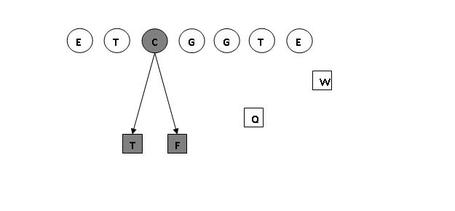
FIGURE 3 - THE SNAP

When the Single Wing was created around the turn of the century, the direct snap was not legal (e.g. today's QB-under-center snap). Instead, the ball had to be tossed back to a ball carrier in a manner similar to the modern shotgun snap. (Earlier, during football's very early years, the ball was put into play rugby-style, by being sort-of kicked back by the center. The American changes instituted the handling of the ball by the center, but the distance requirement remained and the ball was put into play in a shotgun-style snap for a long time.)

Here, the center snaps to either ‘back as the play dictates. However, it's not just a matter of snapping to one of two slightly skewed positions; the ball was usually snapped to some position in front of the receiving ‘back in their line of path. This gave the initial ball handler an extra step on the play but required much of the center. Aside from the usual snap-then-get-your-head-up-and-block skill, the center had to have sure hands and be full of self-confidence. (Hmm... do we know where a center with those traits might be found?)

But why move the center to the side? Couldn't he snap the ball like that from his now-customary position? Certainly. Actually, there are balanced-line Single Wing formations; the Single Wing displayed in the O&W game had a balanced line, in fact. But take a look at what is gained by moving the center:
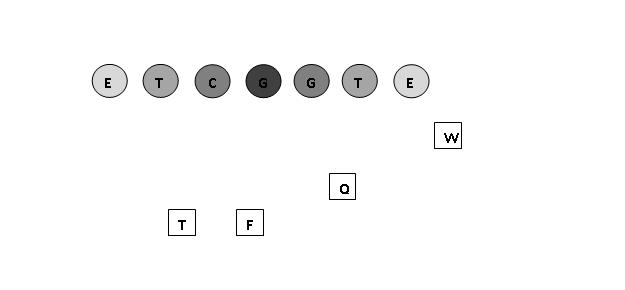


FIGURE 4 - A DIFFERENT LOOK AT THE LINE

Take a look at the line -- not in terms of player position titles, but from the inside out. Remember that the center, because of his task of snapping the ball, is always about a half step behind the rest of the linemen in getting out of his stance. In modern formations, that means that the hinge of nearly every blocking scheme lags the rest of the line. In the Single Wing, that lag has been moved slightly to one side. If you consider the ends as linemen (which is what they were, historically) then you have the awesome result of having four linemen in a row that can all move in true unison at the snap of the ball. Take a second look at that in the above formation and let your mind wander just a bit on the possibilities.

By now, you've probably also noticed that those same linemen also have the backfield focused behind them. The Single Wing has an incredible amount of running power focused to the strong side once you start imagining the blocking and running possibilities. (Again, remember that the quarterback here is not Peyton Manning; this quarterback calls plays but he is usually a blocker, occasionally a receiver, and occasionally a runner. He may pass, but that would be rare.)

With all that power to one side, the natural defensive response is to overshift -- to place more players on the strong side than the weak side. As you know, no formation sees widespread use unless it can attack both sides of the field. That is true of the Single Wing as well. There are many reverses, counters, passes, and sweeps to the weak side that can really cause problems for an overshifted defense. But that'd take a long time to explain. For now, just trust me on that and know that others have written on the weakside far better than I could.

I'll continue next time by drawing up a few Single Wing plays. Once we get a good feel for this offense under our belt, we can look at how it might help UT. The results may surprise you.


=======================================

Rocky Top Talk

.

Back to Old School: A Longing Peek at the New Offense

by hooper on Jul 28, 2008 6:00 AM CDT in Tennessee Volunteer Football

Back in the Spring, at the suggestion of Aerobab, our favorite officer-in-training, a few of us tried to meet up at the Orange and White game for a get-together and a chance to see Clawson's new offense (or at least a few hints at it). We very quickly learned that we're not all that good at coordinating a get-together amongst people who've never met, but Joel, Aerobab and I managed to find each other and get prime seats in the end zone. During the game, we saw some outstanding play from the first team on both sides of the ball - particularly from the Berry/Morley duo.

But one moment caught my eye in particular...


Note the 0:54 mark in the above video. You can't really see the formation from the camera angle, but it's a Single Wing. Crompton was split out wide, safely away from anything resembling contact. Jones took the snap and passed for a TD to Denarius Moore. To be fair, the play looked a lot like a running play - a sweep - which allowed Moore to get behind the defense. But the use of the Single Wing formation was quite intentional by Clawson, and there may be more to learn of the upcoming UT offense from that one play than it may seem.

So with those few seconds of a single play, I decided to read up on the Single Wing and try to see a little more what Clawson was experimenting with. Let's face it: other than some grainy pictures of Neyland's teams and the "cloud of dust" reputation, few people know much about the Single Wing. Yet Clawson just used it for a long pass from Jones - something that Cutcliffe never even attempted last year.

Before exploring the Single Wing with regards to 2008 UT football, a question must first be answered: what is the Single Wing? In short, the Single Wing was the dominant offensive formation in the first half of the twentieth century. Due to its relative lack of use in recent times, however, the formation is not particularly familiar to most fans anymore. So before I look at its implications for the upcoming season, let me review the basics of the formation and how it differs from modern formations. As with all things football, pictures tell all:


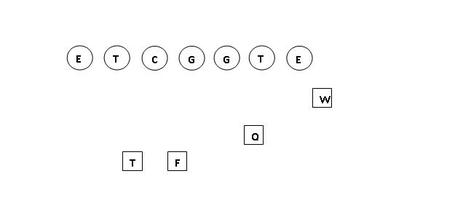
The above picture shows the offensive formation that is perhaps the archetypical Single Wing formation. The linemen are in circles and the backfield players are in squares (as if you didn't already figure that out, I know, but it doesn't hurt to point out that I'll stick with that convention). The abbreviations for the linemen are: C = Center, E = End, G = Guard and T = Tackle. The abbreviations for the backfield are: F = Fullback, Q = Quarterback, T = Tailback and W = Wingback. Other than the lack of wide receivers, this formation has 4 features that are almost never seen in modern (read: pro-style) offenses. Can you guess what they are? I'll explain after the pretty picture that follows (which, if you've scanned ahead, gives away much of it).


Figure 2 - Key Positions in the Single Wing
Ok, the answers:
1. The Center is not between the Guards. This is known as an unbalanced line formation, whereas formations with the center between the guards are known as balanced line formations. (Gee, those football term-makers are creative...)
2. The Quarterback is not behind the Center. In the traditional Single Wing, the Quarterback was usually a blocking back while the Tailback or Fullback received the snap. The Quarterback, however did have the playcalling responsibilities that the modern quarterback has. (This is the main reason why our modern quarterbacks are still called quarterbacks. When the T-formation was created, the quarterback was moved behind center where to coordinate the playcalling with the new-fangled direct snap.) At any rate, remember that the Single Wing was born in an era of run-first (and second and third and ... nth) football; passing came into the formation as a matter of evolution rather than initial design.
3. Neither the Tailback nor the Fullback are lined up directly behind the Center. The center would snap to either ‘back, depending on the play call. More on this in a bit.
4. The Wingback. In pro-set offenses, you don't commonly see somebody lined up behind the tight end. Even the slot receiver is usually a fair distance to the side of the line in order to spread the defense and open up some running room.
At this point, it's a good idea to notice how much sense some position names make when seen in their historical context. Before the Single Wing, the Center truly was the Center of the formation. Guards were so named because they were the blocker who assisted the Center as he was recovering from the snap. Tackles were the guys who, when on defense, made most of the tackles (remember that early football required players to play both ways). Ends were simply the ends of the line, with the term evolving to Tight Ends once receivers became popular. In early formations, the Quarterback was a quarter of the way back from the line, the Halfback was next and the Fullback was the farthest back. Wingbacks flanked the line and Tailbacks lined up askew of the Fullback (like a tail). As you can see, the position terms were once simple to understand, but evolution of the game has made terms like Quarterback and Offensive Tackle a little odd.


Next time, I'll take a look at the dynamics of the formation: what happens once the ball is snapped? It is at this point that the Single Wing really diverges from contemporary offenses.
...Or does it?


=======================================

Rocky Top Talk

.

Wednesday, June 25, 2008

Single-Wing Sentinel Update

45,000 Hits

Just an update -- I put a hit counter on the site 9 months ago and in that time over 45,000+ hits.


There are over 375+ articles posted.

We now have 228 coaches/teams that have signed the Single-Wing Coaches Map (guestbook). We're still showing that there are Coaches/Teams in 48 states, plus the District of Columbia and 6 other nations.

The six countries other than the US are: Canada, New Zealand, France, England, Germany and Austria.

The States without a coach/team showing are:
1. Delaware
2. Vermont

Have you signed? Is your state represented? If not take a second to sign below!

If you know of a team any of the States not showing a team, let me know.

Thanks, to all for making the Sentinel a success!
========================

Single-Wing Apopka waits for TV deal


Apopka-South Panola game waits for TV deal

It's almost July, so it's not too early to talk about high school football. One of the best early-season games will be between Apopka (Fla.) and South Panola (Batesville, Miss.) on Sept. 19 at South Panola. Apopka finished 12-2 last season and made it to the state 6A semifinals, losing 21-18 to Boone (Orlando). The Blue Darters have eight offensive and seven defensive starters returning. South Panola has won 75 games in a row and five consecutive state 5A titles. ESPN spokesman Tilea Coleman said the game is one the network is considering for its high school football schedule, possibly on ESPN2.